Your Global Sales HQ

Blog

Blog Image
AI in eCommerce: How Online Sellers Are Adapting to the Next Wave of Automation

Running an online store right now feels a bit like trying to shovel the driveway during a complete whiteout. You clear one path, maybe you successfully sync up a new dropship supplier, and the wind immediately blows a whole new drift of mismatched inventory right back over your progress.

It's exhausting. Sellers are running off their feet just trying to keep the backend admin from falling apart. Forget actually finding time to sell.

There's plenty of noise about AI in eCommerce. A lot of it gets pitched as this futuristic magic wand that'll somehow run your entire business while you sleep. The reality for anyone actually in the trenches is far more pragmatic. It's more about surviving the daily kerfuffle of multi-channel operations. Nothing glamorous about it.

Look at how quickly things fragment the second you scale past a few daily orders. 

  •       Suppliers operate in their own silos. 
  •       Marketplaces demand totally different formatting. 
  •       Your inbox drowns in update threads that nobody's actually reading anymore.

The Invisible Plumbing of AI automation in eCommerce

This is precisely where eCommerce automation moves from industry buzzword to sheer survival mechanism. It isn't just for generating slightly better marketing copy or spitting out product descriptions.

It's the invisible plumbing. The routing of critical information. Figuring out that a specific item on your Shopify store is the exact same physical product as a completely differently named SKU from your supplier, and that they both need to draw from the exact same pool of stock.

Trying to manage that manually becomes a complete gong show. You end up overselling, canceling orders, and taking hits to your seller metrics that take months to recover from.

Giving up control of those operations is understandably tough. You spent years building up your storefront. Letting an algorithm touch your live listings or dictate your stock levels feels risky. You want to trust the system. But you've probably been burned before by clunky software that promised the moon and delivered a migraine.

Subscription Fatigue Is Real

There's a genuine shift happening in how merchants evaluate software. A few years ago, the move was bolting together five different applications and hoping they played nice. That era is ending.

Your hydro bill is high enough. Paying for a standalone inventory tracker, a separate listing tool, and another app for supplier feeds just inflates monthly overhead without solving the actual root chaos. You're still the one stitching everything together manually. The tools just look fancier while you do it.

Sellers are catching on. What they actually need isn't another band-aid; they need an operating system. One place where everything lives natively, talks to each other without prompting, and doesn't require a full afternoon of troubleshooting every time something updates.

That's the whole idea behind MySellingHub. Supplier connection and automation built in. MSH Chat handles the quick back-and-forths with your team or suppliers. MSH Mail locks down the private, official correspondence — and both sit right there next to your order history, not buried in a separate inbox you keep forgetting to check. The MSH Assistant manages your account and optimizes performance through chat and voice, without requiring your constant involvement. Basically, a keener on staff who never clocks out and doesn't need benefits.

None of that should be a novel concept. But somehow it still is.

The Part Everyone Underestimates

Product mapping. It's easily the worst part of expanding to a new sales channel, and nobody warns you about it properly.

Sellers end up hunting through forums looking for the best AI to automate product tagging in eCommerce, just so they don't have to manually categorize thousands of slight product variations. Fair enough — that work is genuinely awful. But if the tool you find isn't wired directly into your live inventory and supplier feeds, you're still doing half the heavy lifting yourself. You've just moved the problem slightly to the left.

MySellingHub handles this differently. MSH AI Predictions and MSH Assist Suggestions run quietly in the background, continuously looking at your cross-channel items and incoming supplier products. They deliver accurate insights to automatically map and match those items — grouping products from multiple marketplaces into one unified listing backed by a single inventory count. No spreadsheet archaeology. No "wait, which SKU is this again."

AI automation in eCommerce actually works when the system has full context. When it can see everything (supplier catalogues, channel listings, live inventory) the accuracy is genuinely useful. When it's a disconnected plugin sitting on top of three other disconnected plugins, it's just more noise.

What's Actually Coming Next

The sellers paying attention right now are watching a few things develop that haven't fully landed yet. Demand forecasting is getting sharper, not perfect, but still accurate enough that over-ordering and stockout cycles are becoming less of a given. Pricing automation is moving beyond simple rule-based triggers into models that read competitor movement and margin thresholds simultaneously. Supplier reliability scoring is starting to factor into reorder logic automatically, so the decision of who to reorder from isn't purely manual anymore.

None of this is science fiction. Most of it is already in early deployment somewhere. The gap right now is between platforms that are building toward this and platforms that are still figuring out basic sync. That gap is going to matter a lot more in two years than it does today. Sellers who are already operating on unified, AI-connected infrastructure will absorb these capabilities as they roll out. Everyone else will be retrofitting again.

Conclusion

The sellers doing well right now aren't necessarily smarter or better funded. They just stopped operating like it's 2019. They consolidated. They let one system hold the full picture instead of manually updating six tabs and praying nothing drifted out of sync overnight.

That's a subtler shift than the AI hype cycle would have you believe. No dramatic transformation. Just fewer Sunday afternoons reconciling inventory numbers that should've matched on Thursday. Fewer supplier miscommunications that spiral into refunds. A little less chaos every week, compounding slowly into an operation that actually feels manageable.

Worth getting there sooner rather than later.

FAQs

Ecommerce automation is using software or AI to handle routine tasks like inventory updates, order processing, and pricing across multiple sales channels.

Many sellers now prefer centralized systems like MySellingHub, where these processes run together instead of across disconnected tools.

AI in ecommerce is becoming more predictive and integrated into daily operations.

Instead of reacting, systems will anticipate demand and automate decisions — especially within unified platforms like MySellingHub, where AI works directly with operations.

Automation speeds up fulfillment by reducing manual steps.

Orders are routed automatically, inventory updates instantly across sales channels, and tracking is shared in real time — especially when everything runs within one system.

AI in eCommerce uses data to learn patterns, make decisions, and improve processes over time.

It’s now widely used for pricing, inventory, and backend operations — not just customer-facing features.

AI matches products across sales channels by analyzing titles, attributes, and descriptions.

This reduces duplication and keeps listings consistent — especially when managed within a unified system.
...View More
Blog Image
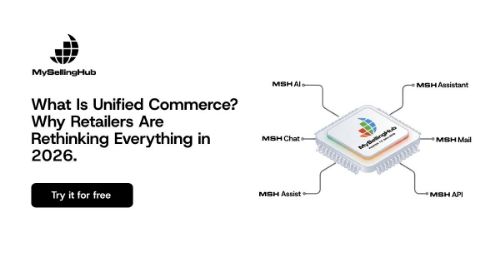
What Is Unified Commerce? Why Retailers Are Rethinking Everything in 2026.

Some businesses grow quietly. Not in revenue - that part is visible. In complexity.

At first, adding another sales channel feels like momentum. Then another supplier. Maybe an agency. A new product range. Everything works. Until it doesn’t feel simple anymore.

Inventory lives in one place. Conversations in another. Listings somewhere else. You can still manage it - but you’re managing the system more than the system is managing the business. That’s the space unified commerce steps into. Not as a trend. More as a correction.

The Subtle Difference Sellers Feel Before They Understand It

There’s a common misunderstanding around unified commerce vs omnichannel. Omnichannel retail solutions connect channels. They synchronize. They integrate. Data passes between systems. Unified commerce does something less flashy but more structural. It removes the idea of “between.” Instead of multiple tools talking to each other, everything operates from one core.

That sounds almost semantic. It isn’t. In multichannel selling, you expand outward. In unified commerce, you pull everything inward first. It’s a shift from coordination to consolidation.

Where Most Growth Starts to Fray

Imagine this: A product sells on one marketplace. Inventory updates there. Another channel lags by a few minutes. A supplier sends a restock message through email. Your agency updates the listing copy in a shared file. Someone on your team confirms availability in a chat thread that doesn’t include everyone. Nothing catastrophic happens. But energy leaks. Unified commerce isn’t really about avoiding disaster. It’s about removing that daily friction. And friction, repeated enough times, becomes fatigue.

MySellingHub Isn’t an Add-On - It’s an Operating Layer

MySellingHub (MSH) positions itself differently from typical omnichannel retail solutions. It doesn’t sit on top of your business. It becomes the environment your business runs inside.
As a unified commerce platform, MSH centralizes:

  • Suppliers
  • Listings
  • Communication
  • Inventory
  • Agencies
  • Automation

All within one shared infrastructure.

Not via patchwork integrations. Through shared infrastructure. That distinction is where most sellers start to feel the difference.

For sellers exploring what MySellingHub is and how it works, understanding its unified infrastructure is the first step.

One Unified Listing. One Inventory. No Duplicates.

Here’s where unified commerce becomes practical.

Inside MySellingHub, multichannel products are mapped and grouped into one unified listing connected to a single, unique inventory source.

Not separate stock pools.
Not mirrored quantities.
One real-time inventory.

When a unit moves on one channel, it updates everywhere instantly because it belongs to the same system.

This is not synchronization.

It is shared architecture.

And that architectural difference:

  • Eliminates overselling risk
  • Reduces manual reconciliation
  • Prevents inventory mismatches
  • Protects operational accuracy at scale

Simplicity at scale requires structure.

Suppliers Are No Longer “Outside”

Most sellers still treat supplier communication as something adjacent to operations.

Emails. Calls. Separate portals.

MySellingHub connects suppliers directly within the platform. Product feeds, availability updates, coordination - it all happens inside the same system where listings and inventory live. There’s something quietly powerful about not switching contexts. You’re not asking, “Did we update that?” You’re seeing it happen where everything else happens. That’s unified commerce strategy in motion - not theory.

Communication Stops Being Fragmented

Operational stress often hides in communication. MSH Chat and MSH Mail bring MyTeam members, suppliers, and agencies into one unified communication system. Conversations live inside the same platform that houses your listings and inventory. No forwarding screenshots. No hunting for context. No wondering who missed the update. It doesn’t feel revolutionary at first. It just feels calmer. Over time, calm compounds.

Agencies Work Inside the Same Structure

Agencies working on behalf of sellers don’t operate in parallel systems. Inside MySellingHub, they create and optimize listings directly within the same unified environment that governs inventory and supplier connections.
No version conflicts.
No disconnected workflows.
Everything operates from the same operational core. That’s where leading solutions for unified commerce are moving - eliminating the invisible gaps between roles.

Intelligence That Doesn’t Demand Attention

Then there’s the layer that runs quietly. MSH AI Predictions and MSH Assist Suggestions analyze product mappings, supplier matches, and cross-channel alignment continuously.

MSH Assistant supports users through chat and voice, helping manage performance without constant manual intervention. It’s not loud automation. It’s steady optimization. And that matters. Because sellers don’t need more dashboards. They need fewer decisions.

Unified Commerce vs Omnichannel - The Real Conversation

Omnichannel retail solutions connect channels. They synchronize data between systems.

Unified commerce eliminates the need for multiple systems to begin with.

In multichannel selling, you expand outward — adding platforms and connecting them.
In unified commerce, you consolidate inward — building from one core infrastructure.

Inside MySellingHub, all connected channels operate from a single unified inventory structure. When a unit sells on one marketplace, stock updates instantly across every channel because it belongs to the same system.

This is not synchronization.
It is shared architecture.

That structural difference eliminates overselling risk, reduces manual reconciliation, and protects operational accuracy at scale.

A Different Way to Think About Scale

Unified commerce isn’t glamorous. It doesn’t announce itself. It feels like fewer tabs open. Fewer mismatches. Fewer “just checking” messages.

MySellingHub wasn’t built to describe unified commerce as a concept. It was built to remove the structural complexity sellers quietly accept as normal. If your business still feels like a network of connected tools instead of a single intelligent system, it may be worth rethinking the architecture underneath. Explore how MySellingHub can unify your suppliers, listings, communication, and inventory into one operational core - and let your growth expand without multiplying complexity. Because in 2026, scale isn’t about being on more channels. It’s about running them as one.

FAQs

Unified commerce is a retail model where all sales channels operate from one centralized system and shared data infrastructure. Instead of syncing separate tools, inventory, listings, suppliers, and communication run from a single core platform in real time.

Omnichannel connects customer touchpoints across platforms. Unified commerce connects the backend systems behind those channels. While omnichannel improves experience, unified commerce improves operational control.

Overselling happens when separate systems update at different speeds. In a unified commerce platform, all channels share one real-time inventory source, so when a product sells anywhere, stock updates everywhere instantly.
...View More
Blog Image
Best Tools to Manage Your Amazon Seller Central Workflow in 2026
Okay, let’s get real for a second. If you’re still running your Amazon business by clicking around Seller Central every day, juggling spreadsheets, an...View More
Blog Image
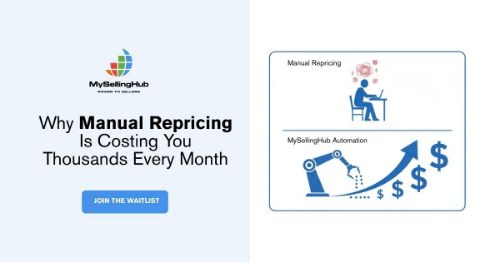
Why Manual Repricing Is Costing You Thousands Every Month
While you’re checking competitor prices once or twice a day, automated sellers are repricing every few minutes. That gap is where Buy Boxes are lost, ...View More
Blog Image
What Is MySellingHub? Everything You Need to Know
If you sell online, you already know the routine. You update a product on Amazon, then repeat the same change on eBay, then Shopify, then Walmart. By ...View More
Blog Image
Amazon Seller Central vs MySellingHub What Works Better for Multichannel Selling
If you’re selling online you’ve probably used Seller Central. It works well for Amazon-only operations. Many sellers use it for basic tasks like addin...View More
Blog Image
What Is Repricing Automation & Why Sellers Need It
In today’s online selling world, things move quickly. One moment your product price is competitive, and the next, a competitor drops their price sudde...View More
eBay’Seller Hub vs MySellingHub: Smarter Tools for Smarter Sellers
When you think of selling on eBay, the first tool that comes to mind is usually eBay Seller Hub. It’s where sellers track performance, manage listings...View More
Blog Image
How MySellingHub Helps You Win the Amazon Buy Box 90% Faster
On Amazon, success isn’t just about having a great product, it’s about visibility. And visibility comes from one place: the Buy Box. More than 80% of ...View More
Blog Image
MySellingHub vs Traditional Repricing Tools: What’s the Real Difference?
Selling online has changed. The days of manually updating prices or relying on outdated repricing tools are gone. In today’s fast-paced eCommerce worl...View More

Address

MySellingHub Inc. 99 South Almaden Boulevard, Suite

600-#7995 San Jose, CA 95113 USA

Contacts

Write to us