


Some businesses grow quietly. Not in revenue - that part is visible. In complexity.
At first, adding another sales channel feels like momentum. Then another supplier. Maybe an agency. A new product range. Everything works. Until it doesn’t feel simple anymore.
Inventory lives in one place. Conversations in another. Listings somewhere else. You can still manage it - but you’re managing the system more than the system is managing the business. That’s the space unified commerce steps into. Not as a trend. More as a correction.
The Subtle Difference Sellers Feel Before They Understand It
There’s a common misunderstanding around unified commerce vs omnichannel. Omnichannel retail solutions connect channels. They synchronize. They integrate. Data passes between systems. Unified commerce does something less flashy but more structural. It removes the idea of “between.” Instead of multiple tools talking to each other, everything operates from one core.
That sounds almost semantic. It isn’t. In multichannel selling, you expand outward. In unified commerce, you pull everything inward first. It’s a shift from coordination to consolidation.
Where Most Growth Starts to Fray
Imagine this: A product sells on one marketplace. Inventory updates there. Another channel lags by a few minutes. A supplier sends a restock message through email. Your agency updates the listing copy in a shared file. Someone on your team confirms availability in a chat thread that doesn’t include everyone. Nothing catastrophic happens. But energy leaks. Unified commerce isn’t really about avoiding disaster. It’s about removing that daily friction. And friction, repeated enough times, becomes fatigue.
MySellingHub Isn’t an Add-On - It’s an Operating Layer
MySellingHub (MSH) positions itself differently from typical omnichannel retail solutions. It doesn’t sit on top of your business. It becomes the environment your business runs inside.
As a unified commerce platform, MSH centralizes:
- Suppliers
- Listings
- Communication
- Inventory
- Agencies
- Automation
All within one shared infrastructure.
Not via patchwork integrations. Through shared infrastructure. That distinction is where most sellers start to feel the difference.
For sellers exploring what MySellingHub is and how it works, understanding its unified infrastructure is the first step.
One Unified Listing. One Inventory. No Duplicates.
Here’s where unified commerce becomes practical.
Inside MySellingHub, multichannel products are mapped and grouped into one unified listing connected to a single, unique inventory source.
Not separate stock pools.
Not mirrored quantities.
One real-time inventory.
When a unit moves on one channel, it updates everywhere instantly because it belongs to the same system.
This is not synchronization.
It is shared architecture.
And that architectural difference:
- Eliminates overselling risk
- Reduces manual reconciliation
- Prevents inventory mismatches
- Protects operational accuracy at scale
Simplicity at scale requires structure.
Suppliers Are No Longer “Outside”
Most sellers still treat supplier communication as something adjacent to operations.
Emails. Calls. Separate portals.
MySellingHub connects suppliers directly within the platform. Product feeds, availability updates, coordination - it all happens inside the same system where listings and inventory live. There’s something quietly powerful about not switching contexts. You’re not asking, “Did we update that?” You’re seeing it happen where everything else happens. That’s unified commerce strategy in motion - not theory.
Communication Stops Being Fragmented
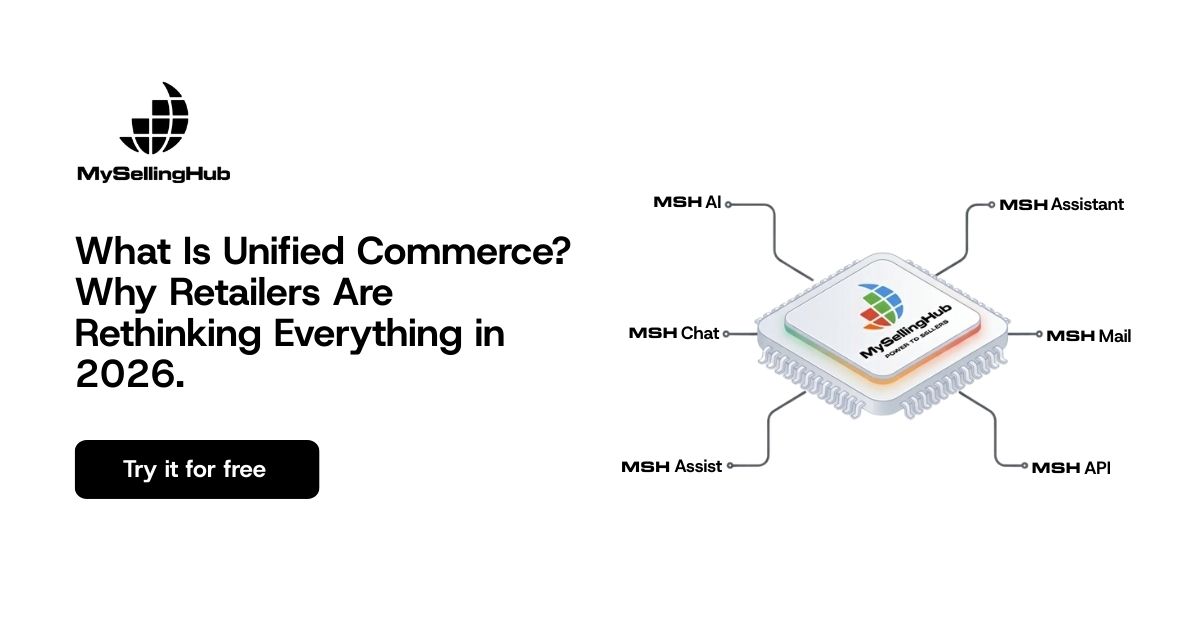
Operational stress often hides in communication. MSH Chat and MSH Mail bring MyTeam members, suppliers, and agencies into one unified communication system. Conversations live inside the same platform that houses your listings and inventory. No forwarding screenshots. No hunting for context. No wondering who missed the update. It doesn’t feel revolutionary at first. It just feels calmer. Over time, calm compounds.
Agencies Work Inside the Same Structure
Agencies working on behalf of sellers don’t operate in parallel systems. Inside MySellingHub, they create and optimize listings directly within the same unified environment that governs inventory and supplier connections.
No version conflicts.
No disconnected workflows.
Everything operates from the same operational core. That’s where leading solutions for unified commerce are moving - eliminating the invisible gaps between roles.
Intelligence That Doesn’t Demand Attention
Then there’s the layer that runs quietly. MSH AI Predictions and MSH Assist Suggestions analyze product mappings, supplier matches, and cross-channel alignment continuously.
MSH Assistant supports users through chat and voice, helping manage performance without constant manual intervention. It’s not loud automation. It’s steady optimization. And that matters. Because sellers don’t need more dashboards. They need fewer decisions.
Unified Commerce vs Omnichannel - The Real Conversation
Omnichannel retail solutions connect channels. They synchronize data between systems.
Unified commerce eliminates the need for multiple systems to begin with.
In multichannel selling, you expand outward — adding platforms and connecting them.
In unified commerce, you consolidate inward — building from one core infrastructure.
Inside MySellingHub, all connected channels operate from a single unified inventory structure. When a unit sells on one marketplace, stock updates instantly across every channel because it belongs to the same system.
This is not synchronization.
It is shared architecture.
That structural difference eliminates overselling risk, reduces manual reconciliation, and protects operational accuracy at scale.
A Different Way to Think About Scale
Unified commerce isn’t glamorous. It doesn’t announce itself. It feels like fewer tabs open. Fewer mismatches. Fewer “just checking” messages.
MySellingHub wasn’t built to describe unified commerce as a concept. It was built to remove the structural complexity sellers quietly accept as normal. If your business still feels like a network of connected tools instead of a single intelligent system, it may be worth rethinking the architecture underneath. Explore how MySellingHub can unify your suppliers, listings, communication, and inventory into one operational core - and let your growth expand without multiplying complexity. Because in 2026, scale isn’t about being on more channels. It’s about running them as one.


