


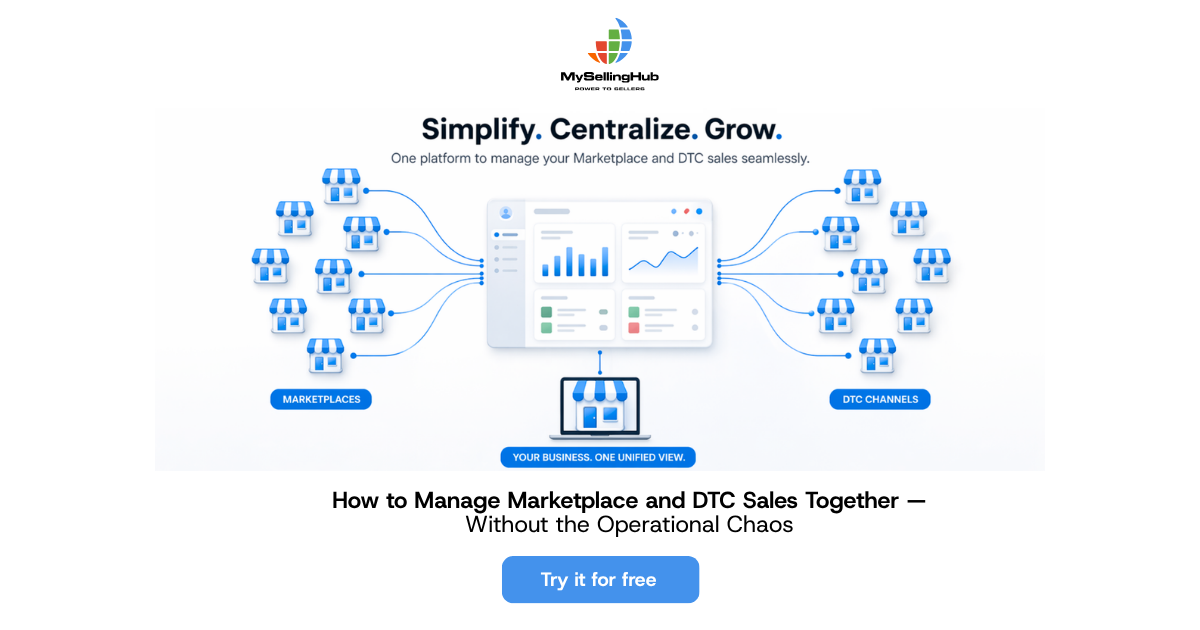
Running a modern online business starts out exciting. You've got your Direct-to-Consumer (DTC) site on Shopify or BigCommerce, you're seeing traction, and someone mentions that Amazon alone carries the largest share of online purchases worldwide. So you list there, too. Then Walmart. Maybe eBay. Possibly TikTok Shop after a few too many late-night rabbit holes.
And then the fun stops.
Not because growth isn't happening, it is. The problem is that behind the scenes, every channel you add brings its own data format, its own inventory rules, and its own expectation of your attention. Before long, you aren't just a brand owner. You're splitting time between fulfillment issues, supplier follow-ups, listing discrepancies, and that recurring nightmare where you sold something on one channel that ran out two channels ago.
The operational tax nobody puts on the pitch deck
Here's what doesn't make it into the "go multichannel!" articles: every new channel doesn't just add revenue. It adds a layer of complexity that grows fast.
Most sellers absorb this cost in two ways. First, in time, hours spent manually reconciling inventory, chasing supplier confirmations, and firefighting. Second, in errors, canceled orders, oversells, and delayed shipments that slowly chip away at ratings and repeat purchase rates.
The average seller juggles 7-10 disconnected tools before switching to a unified solution. And the cost compounds: a missed inventory update triggers an oversell, the oversell triggers a cancellation, the cancellation triggers a bad review, and that review affects ranking. Each of those problems takes time to fix, time that was already scarce.
That's the operational tax. It doesn't show up on a spreadsheet until it's gotten very expensive.
Why each channel feels like a part-time job
The traditional way of managing things is to treat every marketplace like its own island. You log into Amazon Seller Central to answer messages. You log into your DTC backend to update a product description. You ping your supplier in a separate email thread. You check a spreadsheet someone updated three days ago to figure out what's actually in stock.
That fragmented approach is how brands hit a ceiling. You can't scale because you're too deep in the "doing" to think about the "growing." Multichannel commerce has transformed order management from a relatively straightforward process into a complex orchestration challenge. When a customer buys your last unit on Amazon while another simultaneously orders it from your Shopify store, who gets the product? Manual tracking creates these scenarios constantly.
This is where the mindset has to shift from "buying more tools" to "running an actual operating system."
That's what MySellingHub (MSH) was built for. Not another tab to open, but a unified commerce platform. The one place where your inventory, supplier relationships, team communication, and listings all live together. Products across multiple marketplaces are grouped into unified listings with a single inventory count. A sale on Amazon and a sale on your DTC store pull from the same number, in real time. No lag, no reconciliation, no accidental oversell.
That's the foundation of sane multichannel inventory management.
The AI angle that actually saves time
If you've ever tried syncing products across platforms manually, you know how fast it gets out of hand. Every marketplace has its own categories, labeling conventions, and field requirements. Getting "Navy Blue Hoodie - Large" on Shopify to correctly match "Hoodie_Blue_L" on Amazon means someone doing it by hand — and then redoing it every time a product changes, a new variant goes live, or a marketplace updates its taxonomy.
And that's for one SKU. Most growing sellers aren't managing 10 SKUs anymore; they're managing 1,000 or more. At that scale, manual mapping isn't just slow. It's where errors concentrate. A wrong category assignment on Amazon tanks discoverability. A mismatched attribute on Walmart gets a listing suppressed. None of it stands out as a red alert instantly; you just notice, weeks later, that a product isn't selling and start digging.
MSH AI Predictions and Assist Suggestions handles cross-channel item mapping automatically — matching your products across platforms and pairing supplier catalog items to the right sales channels without you acting as the bridge. It's also important for you to know that 80% of top Amazon sellers already sell on other platforms, which means the competition has already figured out that multi-platform presence is non-negotiable. The ones pulling ahead aren't doing it manually.
When you stop reconciling SKUs by hand, that time goes somewhere more useful, actually looking at what's selling, what's sitting, and where to put your next dollar. Sellers using centralized inventory systems see up to 35% fewer stockouts and 22% faster order turnaround across multichannel environments. That's not a marginal improvement. That's the difference between a quarter where things run and one where you're constantly putting out fires.
The manual approach doesn't get more manageable as you grow. It just gets more expensive.
Communication is where things fall apart
Here's something that rarely comes up in the tools conversation: communication overhead.
Between your team, your suppliers, and your customers, there's a constant stream of "did you see my message about the shipment?" and "where's the confirmation for that PO?" Spread across Slack, WhatsApp, email, and whoever last checked the shared inbox, things tend to slip. Either a supplier confirmation gets missed. Or a price update doesn't make it to the right listing. OR a team member acts on outdated info.
MSH Chat and MSH Mail keep business communication inside the platform, tied to the relevant products, orders, and supplier relationships rather than floating in separate apps. The conversation about a late shipment lives next to the inventory record it affects. That sounds like a small thing until you've spent an afternoon trying to reconstruct a timeline from scattered messages.
The MSH Assistant adds another layer. It's not a basic FAQ bot, it handles account management and performance optimization via chat and voice, so routine operational tasks don't require someone manually digging through dashboards.
Marketplaces are not passive
There's a talking point that gets recycled constantly: that marketplace listings are some kind of passive income once they're set up. They're not.
Amazon, in particular runs on performance. Shipping times, cancellation rates, and out-of-stock frequency, all of it feeds into your account health and your listing visibility. Consumers prefer on-time delivery over speedy delivery, and they would rather wait up to a week for an on-time delivery than have a delivery arrive later than expected. Miss enough windows and your listings get buried. Miss a lot, and Amazon starts restricting what you can send to FBA.
The only way to compete on marketplace expectations at any real volume is automation. The back end of your business needs to move as fast as the front end. MSH handles supplier connection and automation natively, so when a sale happens, the chain downstream actually moves.
The brands treating marketplaces like a "set it and forget it" channel are the ones who eventually have a bad quarter and can't figure out why their ranking collapsed. It's usually not a marketing problem. It's an operations problem they didn't catch early enough.
Conclusion
When you sit down to evaluate how your business is actually running, don't just count what the software costs. Count what the time costs.
If you're spending 15 or 20 hours a week on operational chores, reconciling inventory, chasing supplier updates, fixing listing errors, triaging support tickets across platforms, that's time not going into marketing, product development, or customer relationships. For most small and mid-size sellers, that trade-off quietly caps growth without ever announcing itself.
Multichannel ecommerce isn't just about being on more platforms. It's about being able to actually run them without burning out the team. Inventory sync software and unified operations tools are what make that possible — not by eliminating complexity, but by keeping it from growing faster than you can manage it.
Managing marketplace and DTC sales together will always take real effort. But it shouldn't be a source of constant operational chaos. The brands that figure this out earlier tend to look, from the outside, like they grew effortlessly. On the inside, they just built better infrastructure than the people they were competing with.
To explore the difference between marketplace and DTC selling, their pros and cons, and why combining both is the smartest eCommerce growth strategy, read here:
https://www.mysellinghub.com/blog/marketplace-vs-dtc-sales-why-smart-sellers-are-using-both


