


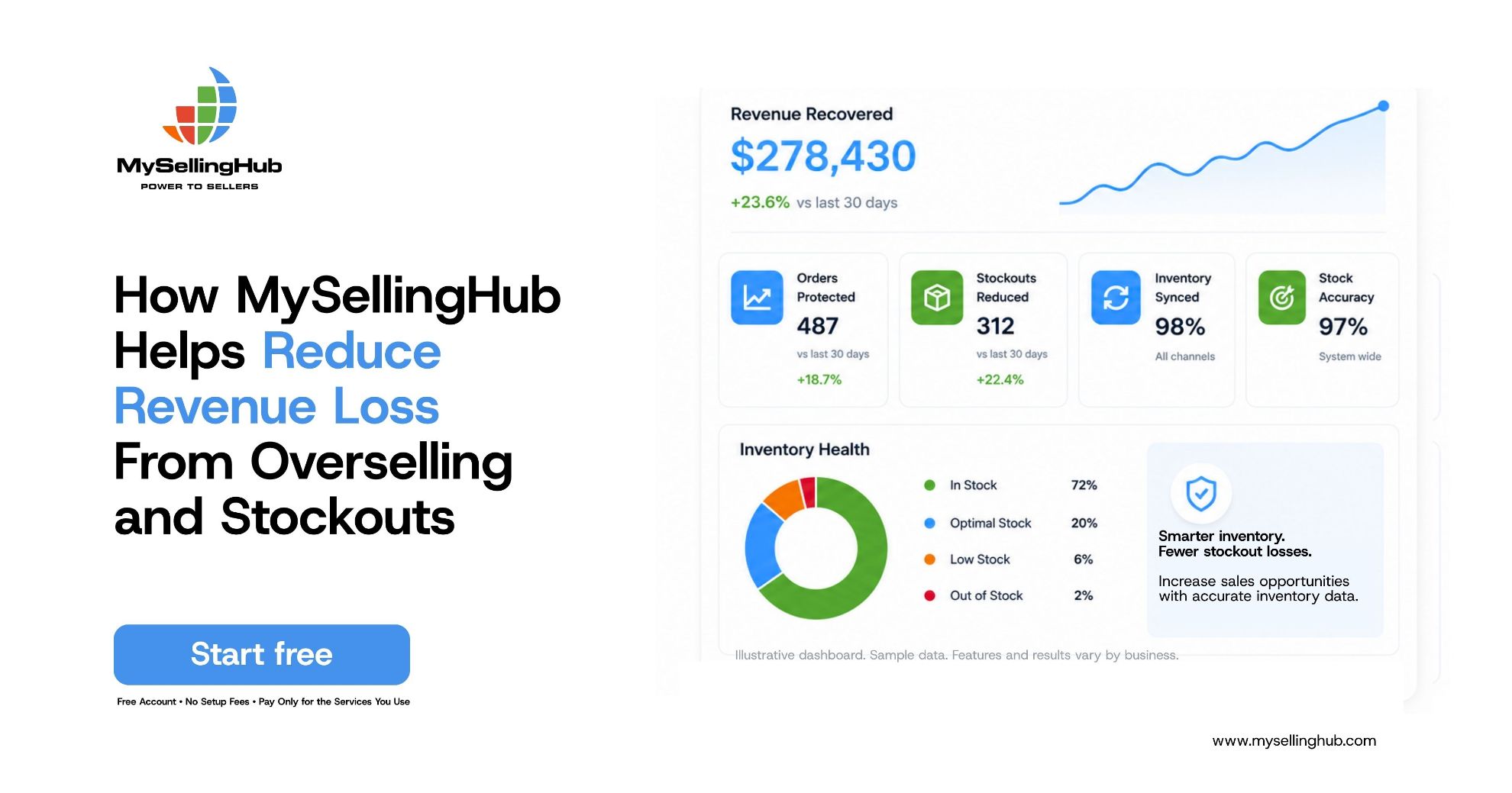
The absolute worst feeling in e-commerce isn't a slow sales day — it's a busy day where your systems betray you.
You hear the notification ping; someone just bought your highest-margin item off your Shopify store. Five minutes later, the same item sells on your Amazon storefront, then it sells again on eBay. You should be thrilled. Instead, your stomach drops. You only had two left in the warehouse. Now you have to deal with an inventory-related cancellation, disappoint a customer, and potentially affect marketplace performance metrics. Repeated inventory-related cancellations can also affect account health and selling performance, depending on the marketplace and its policies.
Repeated overselling can quietly damage a growing e-commerce business. But the opposite problem can be costly too.
Phantom stockouts happen when you actually have the product sitting on a warehouse rack, or your dropship supplier has a thousand units ready to go, but your storefronts say "Out of Stock." You're potentially leaving sales on the table because the inventory shown to customers doesn't reflect what's actually available.
When inventory starts falling out of sync, it's tempting to patch the problem by duct-taping multiple apps together: a syncing tool, a listing tool, a supplier portal. In fragmented setups, inventory information may have to pass between multiple tools and integrations before reaching every sales channel. If there's a fifteen-minute sync delay during the holiday rush, or a TikTok video featuring your product suddenly goes viral, that delay can increase the risk of overselling.
You don't need a faster relay race. You need a single source of truth for your inventory data that helps keep inventory information consistent across connected sales channels.
The invisible cost of playing it safe
After experiencing overselling, some sellers respond by introducing inventory buffers. Say you have 50 units of a highly popular coffee grinder. Instead of making all 50 available across your channels, you may allocate smaller quantities to each channel. You tell Walmart you have 15. You tell Amazon you have 20. You put 10 on your own site. You keep 5 in reserve in case inventory updates don't happen quickly enough.
While inventory buffers can reduce exposure to overselling, they can also limit the quantity made available for sale across channels. Improving inventory accuracy and synchronization can reduce the need to rely on overly conservative inventory buffers. When inventory updates are received from connected sales channels, MySellingHub synchronizes stock levels across them, helping to keep inventory aligned. Greater confidence in inventory data can help sellers make more inventory available across connected channels while maintaining appropriate stock controls.
If you're spending half your week trying to figure out why your inventory never seems to match across platforms, fragmented systems may be part of the problem. When your supplier feed is separate from your listing tool, and your listing tool is separate from your fulfillment center, the risk of inconsistent or delayed data increases.
Why you keep running out of stock (when you shouldn't)
Some apparent stockouts don't start with a lack of physical inventory. They can result from delayed supplier data, missed updates, or communication gaps that don't reach your listings in time. Your supplier got 500 new units in on Tuesday, emailed an updated CSV Wednesday morning, and you didn't get around to formatting and uploading it until Thursday afternoon. Meanwhile, your listings said "Sold Out" for two straight days while 500 units sat waiting.
A fragmented software setup may address individual tasks without removing the underlying gaps between suppliers, inventory data, and sales channels. That's the case for an operating-system model like MySellingHub: bringing supplier, inventory, listing, and sales channel information together within one commerce environment. Through supported supplier connections, inventory information can flow into MySellingHub and across connected sales channels as updates become available through those integrations. This can reduce the need for manual CSV updates where supported, helping reduce delays associated with manual processing.
Inventory accuracy can matter beyond operational efficiency. Inventory-related cancellations and fulfillment issues may affect seller performance and account health, depending on the marketplace and its policies. Keeping inventory information accurate can help reduce avoidable cancellations and backorders.
The SKU mapping nightmare
Here's where things get messy in the trenches. You rarely sell an item under the exact same SKU format everywhere. Your wholesale supplier might call it "BLK-SHIRT-LG-001." You might list it on Shopify as "Mens-Basic-Tee-Black-L." On Amazon, it's tied to a specific ASIN.
Manually cross-referencing these formats across platforms can be time-consuming and prone to human error. Map the wrong supplier code to the wrong listing, and someone who ordered a black shirt gets a red one, while the inventory counts for both may now be inaccurate.
This is where AI-enabled inventory management can become increasingly valuable as the number of channels and SKUs you're managing grows. MySellingHub uses MSH AI Predictions and MSH Assist Suggestions, which are designed to help identify products that appear to represent the same physical item across different data sources. They can assist in grouping supplier SKUs and marketplace listings into a unified inventory model, reducing the amount of manual mapping required and helping minimize errors.
Fixing the broken feedback loop
Inventory problems are rarely just inventory problems—they're often communication problems wearing an inventory costume. A supplier delay, a stuck freight shipment, or a damaged pallet can trigger information that travels through email, Slack, and phone calls before the right person acts on it. By the time the information reaches the right person, customers may already have ordered inventory that is no longer available.
This is why moving to a unified multichannel inventory management platform means rethinking how your team communicates, not just how your stock counts sync. MySellingHub brings that communication inside the platform. Instead of jumping over to Gmail to ask a supplier about a stock delay, you use the built-in MSH Chat and MSH Mail, talking to your team and your suppliers right there alongside your inventory data. When a supplier messages about a short shipment, you can respond and take action within the same MSH environment.
And if you're overwhelmed, the MSH Assistant is there — supporting you via chat and voice, assisting with day-to-day account management and providing recommendations to help optimize operations — so you're not stuck babysitting a dashboard. See how AI in e-commerce is changing how sellers operate.
The endgame of total unification
At some point, more standalone apps just means more places for data to get stuck. Moving everything into one hub means you stop managing software and start managing the business. Migrating is real work, but evaluating the potential return is worthwhile. Disconnected systems can create costs through overlapping subscriptions, manual work, operational inefficiencies, and missed sales opportunities. Understanding those costs can help sellers assess the potential value of moving to a more unified approach. See the ROI breakdown here.
You shouldn't have to hold your breath every time your phone pings with a new order, or manually throttle your own sales because you don't trust your tech stack to keep up. MySellingHub helps organize products into a unified inventory model, connects suppliers through supported integrations, and uses MSH AI Predictions and MSH Assist Suggestions to assist with SKU mapping that would otherwise require significant manual effort. It doesn't make chaos impossible. It just means less of it reaches your customers.
If you're also running both marketplace and DTC channels, read How to Manage Marketplace and DTC Sales Together Without the Operational Chaos.
Features and functionality may vary depending on the capabilities, policies, and availability of each supported marketplace, commerce platform, and integration, and may change over time as MySellingHub continues to evolve.


