


Inventory doesn’t fall out of sync because of one catastrophic mistake.
More often, it's the result of small issues piling up over time.
A product sells on one channel, but the update takes a few minutes to reach another. A supplier changes availability, but the information doesn't make it everywhere. Someone adjusts stock levels manually and forgets to update another system. None of these issues seem significant on their own. Together, they create the kind of inventory chaos that sellers deal with every day.
One minute everything looks fine. The next, you're cancelling orders, apologizing to customers, or trying to figure out which stock number is actually correct.
As businesses expand into multiple marketplaces, websites, and sales channels, these problems become harder to ignore. More channels create more opportunities for inventory data to drift apart.
The frustrating part? Most sellers already have software in place.
Yet inventory problems continue to show up.
The reason is simple. Having more tools does not automatically create better visibility. In many cases, it creates more places for information to become disconnected.
That is exactly the problem Unified Commerce was designed to solve.
The reason inventory keeps falling out of sync
Many businesses assume inventory issues are caused by poor processes or human error.
Sometimes they are.
More often, the root cause is fragmentation.
Inventory lives in one system. Listings live somewhere else. Supplier information sits on another platform. Orders flow through multiple channels. Communication happens across emails, spreadsheets, and messaging tools.
Individually, each system may work perfectly.
Collectively, they create gaps.
When information has to move between disconnected systems, delays become inevitable. A stock adjustment made in one place may not immediately appear somewhere else. Returns might be processed differently across channels. Product listings can become disconnected from actual inventory levels.
Over time, those small inconsistencies start piling up.
That is why so many businesses find themselves dealing with overselling, stock discrepancies, duplicate work, and constant inventory reconciliation.
The problem is not necessarily the people managing the business.
The problem is that everyone is working from different versions of the truth.
Why more channels often create more problems
The rise of online marketplaces has made it easier than ever to reach customers.
It has also made operations significantly more complicated.
Most sellers today are not relying on a single storefront. They are managing products across multiple marketplaces, websites, supplier networks, and fulfillment workflows.
On paper, this looks like growth.
Behind the scenes, it often creates a new challenge.
Every additional sales channel introduces another place where inventory needs to stay accurate.
This is where many businesses turn to multichannel selling software.
These tools can help publish listings, manage orders, and expand channel reach. They solve part of the problem.
But they do not always solve the inventory problem.
A business can appear highly organized from the outside while still struggling internally with mismatched stock levels, duplicate listings, and inconsistent product information.
Teams stay busy because they are constantly checking, correcting, and reconciling data.
The operation grows.
The complexity grows faster.
The difference between omnichannel and unified commerce solutions
The discussion around omnichannel vs unified commerce often gets reduced to technical definitions.
In reality, the difference shows up in daily operations.
Omnichannel strategies focus on creating a consistent customer experience across multiple sales channels. Customers can interact with a brand through different touchpoints without feeling disconnected.
That’s undeniably important.
But customer-facing consistency does not automatically mean the systems behind the scenes are connected.
Many businesses still operate with separate inventory systems, separate communication tools, separate supplier processes, and separate operational workflows.
Everything appears connected.
Underneath, the business is still stitching information together manually.
A unified commerce platform takes a different approach.
Instead of connecting multiple independent systems, it creates a single operating environment where inventory, orders, listings, supplier information, and business communications work together from the same source of truth.
The difference may seem subtle.
Operationally, it changes everything.
What unified commerce actually fixes
The value of Unified Commerce is not found in a dashboard or a feature list.
It is found in the problems that stop happening.
When inventory updates are connected across the business, stock discrepancies become less common. Listings remain aligned with actual availability. Orders reflect current inventory levels. Teams spend less time investigating inconsistencies and more time focusing on growth.
A true unified commerce platform creates one place where information can be managed and trusted.
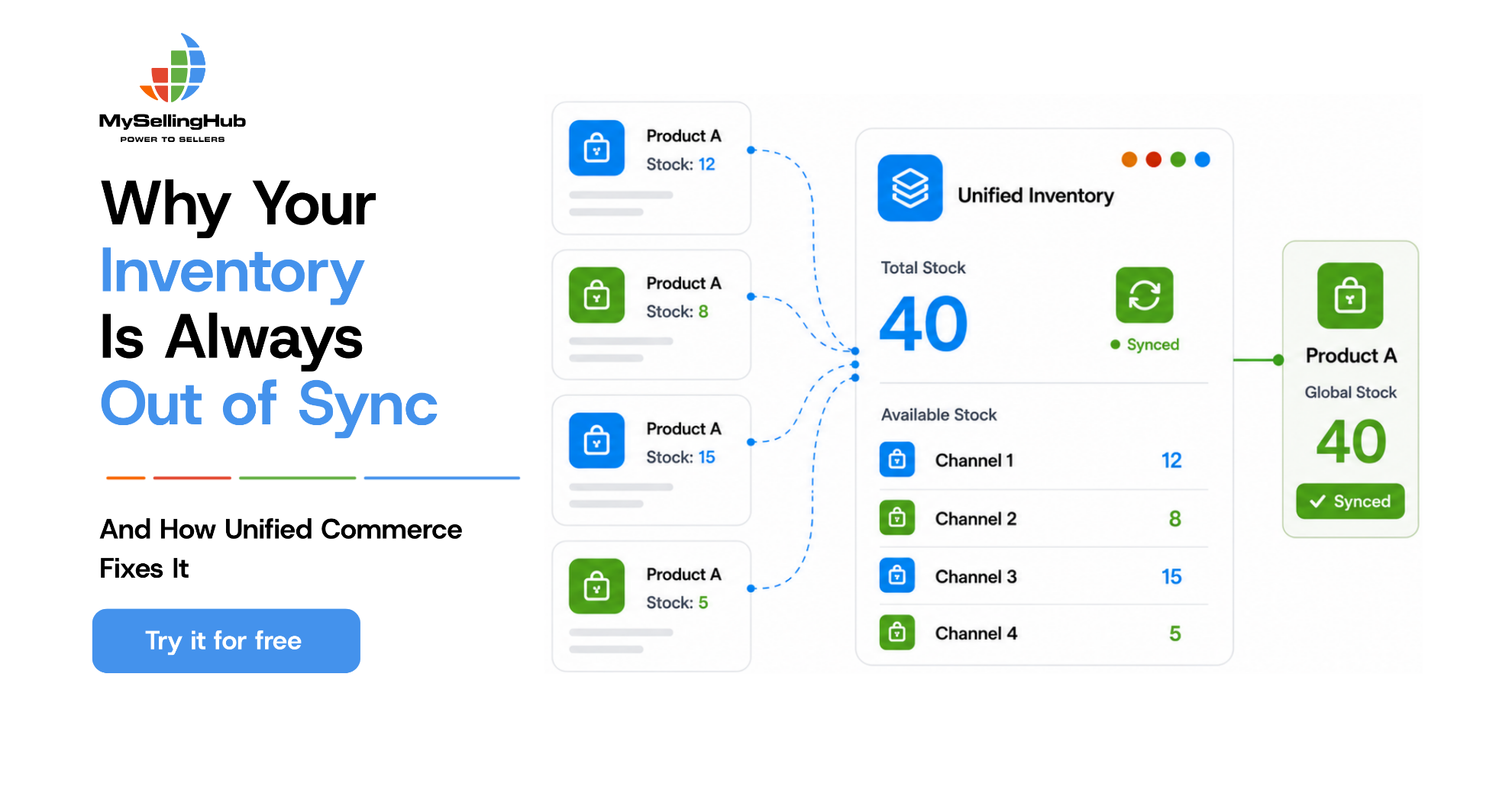
Instead of maintaining separate inventory counts across multiple channels, products can be intelligently grouped into unified listings that share a single inventory source.
This removes a surprising amount of operational friction.
The business no longer needs to constantly verify whether different systems are showing different answers.
Inventory becomes something the team can rely on rather than constantly monitor.
For growing businesses, that shift can have a significant impact on efficiency.
The growing role of AI-enabled inventory management software for automation
Automation keeps systems running efficiently.
Artificial intelligence adds another layer of intelligence on top.
Modern AI-enabled inventory management software for automation can help businesses identify patterns, detect anomalies, and reduce the amount of manual oversight required to manage large product catalogs.
Rather than simply recording activity, AI can assist with tasks such as matching products across channels, identifying catalog inconsistencies, and helping teams maintain cleaner inventory data.
This becomes especially valuable as operations grow.
Managing hundreds or thousands of products across multiple sales channels is difficult enough.
Managing them manually becomes nearly impossible.
That is why many growing businesses are beginning to view AI not as a future capability, but as a practical operational advantage.
How MySellingHub helps bring everything together
MySellingHub was built around a simple idea: running an eCommerce business should not require a collection of disconnected tools.
As a unified commerce platform, MySellingHub brings together inventory, supplier connections, listings, communication, and operational workflows into a centralized system.
Products from multiple marketplaces can be intelligently grouped into unified listings connected to a single inventory source.
Supplier relationships can be managed directly within the platform.
Teams can communicate through built-in tools like MSH Chat and MSH Mail instead of relying on scattered conversations across multiple platforms.
Meanwhile, MSH Assistant, MSH AI Predictions, and MSH Assist Suggestions help reduce manual effort by supporting catalog management, product mapping, and operational decision-making.
The goal is not to add more software to the business.
The goal is to eliminate the need for so much software in the first place.
Conclusion
Inventory issues rarely begin with inventory itself.
More often, they begin with disconnected systems, fragmented data, and processes that struggle to keep up as the business grows.
The solution is not adding more tools. It is creating a connected environment where inventory, orders, suppliers, listings, and communication work together.
That is the value of Unified Commerce.
When everyone in the business is working from the same information, inventory becomes easier to manage, operations become more efficient, and growth becomes far easier to sustain.
FAQs
No manual updates, no separate dashboards, and no overselling. Platforms like MySellingHub are built on this principle — one centralized hub to run your entire ecommerce operation.
- No more overselling — one live inventory count across every channel.
- Centralized orders — all orders from all platforms in one dashboard.
- Real-time stock sync — updates the moment a sale happens, anywhere.
- Consistent pricing — change a price once, and it reflects everywhere.
- Less manual work — no more copy-pasting orders or reconciling data across tools.
- Better reporting — one consolidated view of sales, revenue, and performance across all channels.
For ecommerce sellers, poor inventory management directly leads to lost sales, negative reviews, and marketplace penalties.
For multichannel sellers specifically, it ensures that what shows as "available" across your storefronts is genuinely in stock and ready to ship — across every platform simultaneously.


