


A seller checks stock on Amazon. Ten minutes later, they check the same SKU on Shopify. The numbers do not match.
Neither system is necessarily broken. They are working from different information, updated at different times, through tools that were not designed around the same underlying record.
That is the problem MSH OS is built around.
Not the AI layer. Not the chat interface. Not another dashboard. The record underneath all of it.
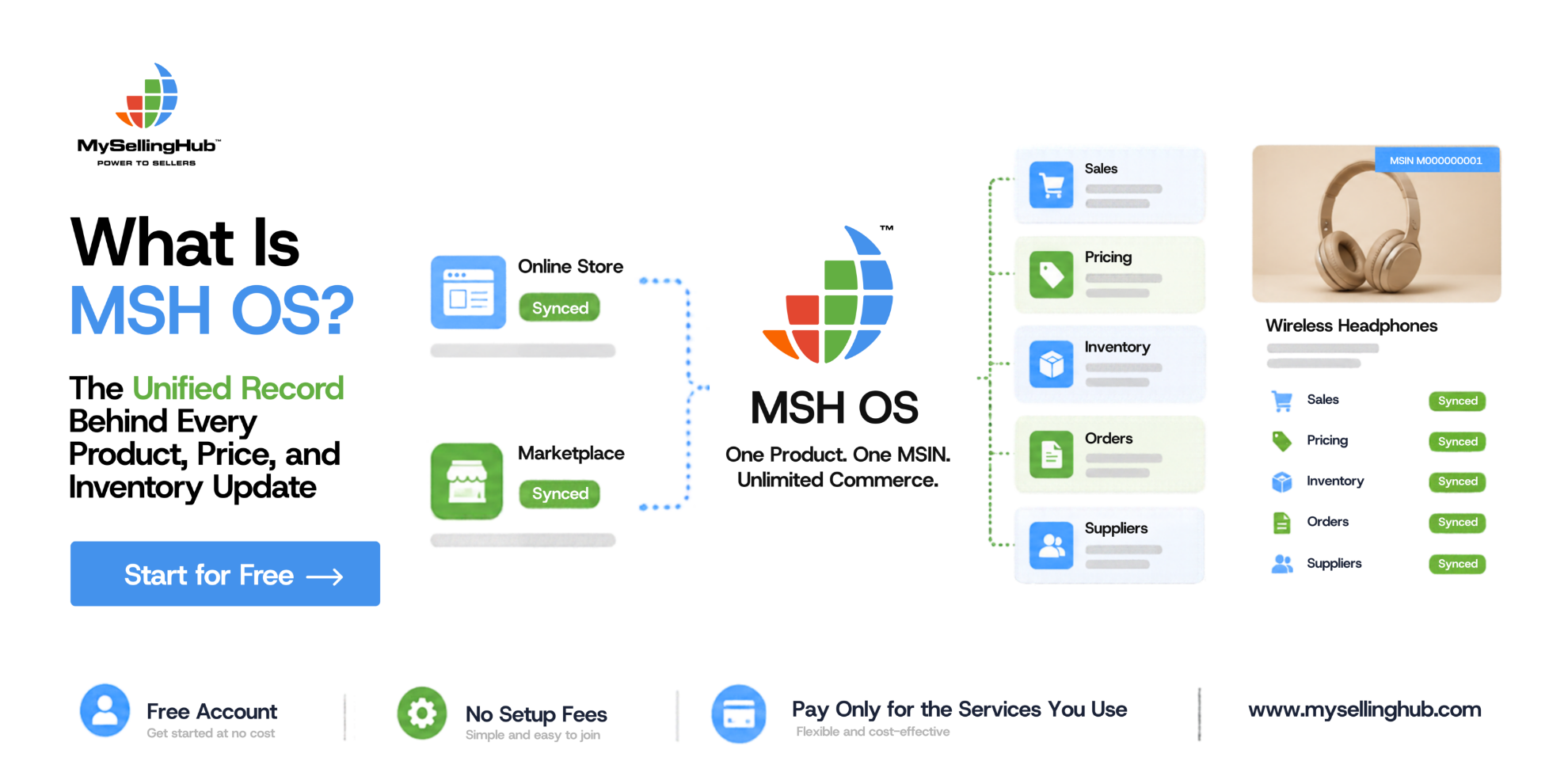
MSH OS is the operating system behind MySellingHub’s commerce environment. When a product enters the ecosystem, it is assigned a unique MSIN (MySellingHub Stock Identification Number, if you're wondering). From there, that identifier becomes the reference point as the product moves through listings, inventory, orders, pricing, suppliers, customers, warehouses, and connected sales channels.
That small detail changes how the rest of the system can work.
Why the product record matters more than another dashboard
A multichannel seller can have one product appearing on Amazon, eBay, Walmart, Shopify, and other storefronts. Each channel has its own listing. The supplier may use a different SKU. A warehouse may track the physical units differently.
The item is still the same product.
MSH OS is designed to give that product one identity inside the MySellingHub ecosystem.
The MSIN provides a common reference point for relevant commerce information associated with that product record. Pricing, inventory, orders, supplier information, customer activity, sales channels, and business rules can all work from the same underlying structure.
That is the useful part of a unified commerce platform. The goal is not simply putting several tools under one login. It is giving those tools a common foundation to work from.
For sellers already dealing with multiple systems, that distinction can be significant.
What happens when the product moves?
Take a routine price change.
A seller changes a price because market conditions shifted or a competitor moved. In a disconnected setup, that update may need to be handled separately across channels. Even when integrations exist, there can still be multiple records and processes involved.
With MSH OS, pricing is connected to the same product record as the rest of the commerce activity. From there, supported workflows can carry the information into connected channels.
Inventory follows a similar idea.
A sale, return, adjustment, or other inventory event can change available stock. That stock position is relevant to listings, orders, suppliers, and future sales. Keeping those pieces connected gives the seller a common place to work from instead of rebuilding the same context in several systems.
The practical value comes from what that can reduce: repeated checks, duplicated updates, and the ongoing question of which number is actually current.
For a closer look at the financial side of consolidating operations, read what switching to a unified commerce platform can change from an ROI perspective.
Inventory is where the shared record really gets tested
Inventory problems tend to show up when a business has enough moving parts for small delays to become expensive.
A product sells. Stock changes. Another channel still shows availability. A supplier sends an update. Someone on the team notices it later.
None of those events has to be dramatic.
The trouble comes from the gaps between them.
MSH OS is designed to support real-time inventory management, with inventory activity connected to the shared MSIN record. Where the relevant marketplace and integration support the necessary update, a stock change can flow through connected parts of the operation without someone having to make a separate manual adjustment everywhere.
The exact timing can depend on the channel, integration, and account configuration. That is important when evaluating any commerce platform.
There is more on the underlying problem of why inventory keeps falling out of sync and how unified commerce can address it.
Where Amazon fits into the picture
Amazon can be the center of a seller’s business without being the only place that business operates.
There may be a Shopify store behind it. Other marketplaces. Suppliers. Warehouses. Internal teams handling listings and orders.
That wider setup is where MSH OS can serve as Amazon inventory management software. Amazon inventory can be part of the same product record used across the rest of the business rather than treated as a completely separate operation.
And inventory is only one piece.
Pricing, orders, supplier information, product data, and channel activity are designed to connect back to the same underlying structure. That makes MSH OS relevant to Amazon seller operations without limiting it to Amazon.
The marketplace is one part of the operation. The MSIN is designed to give the product continuity across it.
What sits on top of MSH OS?
This is where the rest of the MSH ecosystem comes in.
MSH Assistant is designed to provide intelligent support across business operations. Ask MSH is built to give sellers a natural-language way to access business information and request actions. MSH AI is designed to support automation across areas such as inventory synchronization, pricing, listing workflows, competitor monitoring, product enrichment, and translation, where supported by the relevant integrations and workflows.
MSH Intelligence is designed to work with business data to surface trends, opportunities, insights, and recommendations.
Then there are MSH Chat, MSH Mail, MSH Assist, MSH API, and the MySellingHub App, each intended to extend the same connected environment into communication, mapping, integrations, and mobile access.
That structure matters because these tools are not meant to operate on isolated fragments of the business.
Ask MSH can answer a question about sales or inventory because there is an underlying system holding that information. Automation can act on business rules because those rules have data to work with.
The intelligence layer is only as useful as the records underneath it.
What should sellers actually look at when evaluating MSH OS?
The easiest thing to compare in software is a feature list.
The harder question is what happens to the data underneath those features.
A seller evaluating MSH OS should look at how products are identified, how connected channels reference them, how inventory is handled, which integrations are supported, and how pricing, suppliers, orders, and automation fit into the same operating model.
The MSIN is the key piece here. It is designed to give each product a persistent identity inside the MSH ecosystem, creating a common reference point as that product moves through different parts of the business.
That is ultimately what MSH OS is about.
Not adding another place for sellers to log in.
Creating an underlying record that the rest of the operation can actually use.
FAQs
Disclaimer: Results will vary depending on your business processes, connected marketplaces, suppliers, integrations, and how MySellingHub is configured and used. Features and functionality may vary depending on the capabilities, policies, and availability of each supported marketplace, commerce platform, and integration.


